Wednesday, January 27, 2016

The Perry Expedition (1853-1854) and the Japanese Encounter with “Religion”

By Mitsutoshi Horii, Shumei University

*This post originally appeared in Critical Religion


Under orders from American President Millard Fillmore (1800-1874), Commodore Matthew Calbraith Perry (1794-1858) commanded an expedition to Japan in the 1850s. After more than 7 months at sea, Perry and his squadron finally reached Uraga, at the entrance to Edo (Tokyo) Bay in Japan, on 8th July 1853.

The Perry Expedition carried a letter from the President of the United Sates to “the Emperor of Japan” (in fact, meaning the Shogun)[1]. This letter was drafted in 1851 by Daniel Webster (1782-1852), and was signed by President Fillmore. This was accompanied by another letter written by Perry himself. These letters contained the English words ‘religious’ and ‘religion’, though there were no equivalent concepts in Japanese at that time.

The letters were presented by Perry to the Japanese officials on 14th July 1853, at Kurihama (present-day Yokosuka). Chinese and Dutch translations were provided together with the English originals. However, it was the Chinese translation from which the widely-circulated Japanese translation was produced. This was the first time the Japanese had encountered the English language concept of religion.

The original English letters were translated into Chinese by the expedition’s chief translator, Samuel Wells Williams (1812-1884), and his Chinese assistant. The process of translation was not an easy one. William’s Chinese assistant spoke Shanghainese, while Williams could only speak Cantonese at that time. Speaking different dialects, they had trouble understanding each other. In addition, with regard to the generic notion of religion in the letters, the Chinese language had no equivalent either.

Whilst translating President Fillmore’s letter into Chinese, the phrase “religious or political” was interpreted as 政礼, meaning ‘governance and rites’. By the mid-nineteenth century, the English language had already established the notion of ‘religion’ as distinct from ‘politics’. In contrast, the Chinese terms of ‘governance’ (ching) and ‘rites’ (li) did not have the same binary relation as ‘politics’ and ‘religion’, and carry very different nuances. Whilst ching implies the ruling of a territorial country by the imperial authority, li denotes the code of human conduct encompassing both the private and the public realms. Li renders the general sense of propriety and etiquette, which cannot be confined in the modern western notion of ‘religious’.

The Japanese version of the letter inherited the Chinese phrase 政礼 (governance and rites) in place of the English phrase “religion and politics”. When it came to be bilaterally translated into Japanese, however, the meaning was once again transformed. In the mid-nineteenth century, the Chinese ideograph, ching政, was read in Japan asmatsurigoto, which is derived from the word matsuri, meaning ‘to worship’. The concept of matsurigoto indicates that the purpose of human governance was “to celebrate the deities who created the realm and the people” (165). It contained an element which can be regarded as ‘religious’ in the modern sense.

As for the Chinese concept of li (rites), it was read as rei in Japan. While the Chinese concept of li represents the Confucian concept of propriety, in mid-nineteenth century Japan, the notion of rei was understood as norms of respecting existing social hierarchy. In this conceptualization, it is very hard to regard rei as the equivalent to the western notion of ‘religious’ as distinct from ‘political’. The Protestant notion of private faith, as articulated by the term ‘religious’, was bilaterally translated into the Japanese concept of rei, as a set of cultural codes which encompassed the entire social practices, including governance.

A similar transformation of meaning can be found in the process of the bilateral translation of Perry’s letter which accompanied President Fillmore’s letter. Whereas Williams used the term li to translate the adjective ‘religious’ in Fillmore’s letter, he chose the Chinese word kiáu教, for the noun ‘religion’ in Perry’s letter.

As Williams’ own publications in Sinology indicate, the mid-nineteen century Chinese notion of kiáu was much broader than the Western concept of religion as private faith. For example, the definition of kiáu in Williams’s 1856 dictionary is: “To instruct, to teach, to show how; to command, to order; precept, principle, rule; doctrines, tenets; a religious sect, a school, or those who hold to the same opinions” (144). In addition, kiáuindicates a kind of hierarchical harmony between the old and the young, and between ruler and subjects (372). It is also a kind of teaching to be transmitted from the old to the young, and from ruler to subject (372). The notion of kiáu was much broader than the Western category of religion, with a strong sense of ancestral traditions, which included families and the state.

The Chinese character for kiáu was employed in the Japanese translation of Perry’s letter. In the Japanese language, the same ideograph is read kyō. It is also pronouncedoshie. As kiáu does in Chinese, the Japanese notion of kyō or oshie refers to the generalized idea of teaching or teachings. However, the Japanese concept of kyō oroshie seems to have moved away from the strong hierarchical connotation which is apparent in its Chinese meaning. For the Japanese, it meant a kind of systematic knowledge constituting the basis for public morality and the outward form of state ritual (161). In this sense, it was likely that such things as the constitutional systems and state ceremonies in Europe and America, would have been categorized as kyō by the Japanese (162). In this light, the tacit distinction between religion and the magistrate, which Perry made in his letter, almost completely disappeared in the Japanese version.

Following on from the Perry Expedition, President Franklin Pierce (1804-1869) appointed Townsend Harris (1804-1878) in 1855, to be America’s first consul to Japan. Harris opened the first US Consulate in Japan in 1856. He successfully negotiated the Treaty of Amity and Commerce (also known as ‘Harris Treaty’) of 1858, in which he inserted a clause on ‘religion’.

The American projection of ‘religion’ onto Japan in the mid-nineteenth century was an integral part of America’s Christian imperialism, powered by its self-belief in its divine mission in the world. The generic idea of ‘religion’ was brought to Japan by the Perry expedition, and subsequently by Harris, in this cultural context. These issues are fully examined in my forthcoming article, ‘American Imperialism and the Japanese Encounter with “Religion”: 1853-1858’, which will be published this year in the special issue of the Sapienza University of Rome’s Studi e Materiali di Storia delle Religioni.


[1] Perry mistakenly thought the Shogun was an emperor, while the Japanese historically conceptualized the Shogun as the Emperor’s military commander.

Monday, January 25, 2016

Pleasantville and Social Reproduction

By Craig Martin


In Religion & Society—my introductory religious studies course—I regularly use the 1998 comedy Pleasantville to engage in a discussion about how we’re socialized to actively seek conformity to the existing social order. The film is about two teens—David, played by Toby Maguire, and Jennifer, played by Reese Witherspoon—who are magically transported from the 1990s into a 1950s sitcom; they immediately begin to chafe under the social expectations of small town life. As they start deviating from the social norms of the fictional sitcom world (and encourage others to do so as well), they disrupt the life of the entire town. (If you haven’t seen it, the trailer is below. Note: there are spoilers further down.)


The film is all about the internalization and breaking of social norms—that is, social reproduction and contestation. On the one hand, life in the invented TV town is unrealistic and absurd: there are no toilets in the bathroom (because people in 1950s sitcoms weren’t shown defecating), their parents don't know what sex is (because sex never comes up in programs from the 50s), fire doesn’t burn, the basketball team never loses a game, etc. On the other hand, the absurdity of the way of life modeled in the sitcom doesn't prohibit the internalization—by the TV audience—of the social norms modeled. At the end of the film, after David and Jennifer return to their “real” world, we see David’s divorcee mom sobbing because she internalized exactly the sort of social norms she presumably learned from television shows like this one as a child (women are supposed to be married, have a perfect home, perfect children, white picket fence, etc.). She’s thoroughly ashamed of herself for not living up to the model she had internalized.

But shame is not the only response shown by the characters in the film when deviating from the norm. Some experience deviance as pleasurable and liberating, and others respond to deviance by attempting to restore the status quo via ridicule, shaming, new community regulations, or even violence. The film tends to present the responses to change as falling on one of these two sides: those who are bold and transformative, and those (cowards?) who want to keep things the same. It is not always so simplistic though; some of those who stand to lose (privilege or power, for instance) from social transformation are presented as pitiable at times. As David and Jennifer’s TV mom leaves their TV dad, their father is left confused and lost, not knowing how to cook or clean or care for himself alone.

Much of the film advances a sort of liberal ideology: desire is deep inside you, needs to come out, although its fulfillment is often blocked by people who are cruel or wrongly controlling. In those scenes that fit with this ideology, deviance from social norms is experienced as pleasurable and liberating.

On the other hand, there is much in the film that is in tension with this ideology. It's clear that desire don't simply come from deep within, but rather has its origin in part from the socialization process: the movie is itself a commentary on the effects of television itself in creating (potentially tragic) subjects of a certain type. The two most telling and poignant scenes in the movie are the parallel ones where David speaks with his two moms, both of whom are crying because they’re ashamed of their own deviance. In the first (see the clip below), David helps to put gray makeup on his sobbing TV mom after she turns from black and white to color, in order to help her appear to conform and “pass” as normal once again. Later, at the end of the film, he does the reverse: he helps to remove makeup from his “real” mom, all the while telling her that it is okay not to have the life to which she once aspired. Both of those women do not at all experience deviance from social expectations as liberating; on the contrary, they're so deeply ashamed and confused that they’re paralyzed.


In our class discussion I point to how the liberal model of deviance as liberating is highly problematic. Most of us are more often like David’s two moms when we break social norms we've deeply internalized—we experience it as disconcerting and shameful. The most effective social controls are the ones that invite us to police ourselves.

Thursday, January 14, 2016

"Welcome Back, This is Not a Spiritual Shopping Store"

By Tenzan Eaghll


A simple point that I like to make on the first day of any Religious Studies course is the following: this is not a "spiritual shopping store." I make this point by stressing what we are not doing in the course: we are not searching for the truth about religion.

When some students first think about taking a class on religion they often do so under the assumption that Religious Studies will help them navigate between the different religions of the world, and thereby make wise spiritual choices in their personal lives. These students tend to think of Religious Studies as an aid to help them choose the best religion ("Buddhism vs. Islam, Yah!") or as an aid to overcome religious institutions all together and be an informed spiritual agnostic ("I took a class on religion once and saw that it is all made up, so now I am spiritual but not religious"). This popular approach to the subject is what leads students to think of the Religious Studies classroom as a "spiritual shopping store"—a way of learning the truth about religion, or life, for that matter. They enroll in a religion class to read books on mysticism because they think that is what real religion looks like ("OMG, Saint Francis of Assisi was the real deal, everything else is just hypocrisy"). Or, to study Jainism because they think the idea of ahimsa is the only truth that can save our confused world ("non-violence is the only answer").

To underline the fact that this "spiritual shopping store" approach is not what we are doing in class, I like to show the following clip from Woody Allen's 1984 movie, Hannah and Her Sisters. Now, I love Allen and I love this movie, but it is a perfect example of how not to approach Religious Studies:


I use this clip to introduce students to the a priori assumptions they may have about religion, as it provides a perfect example of  what Timothy Fitzgerald calls The Ideology of Religious Studies.  If you watch the clip closely, you will notice that Allen imagines religion to be a private space of belief, a sanctuary of meaning and value in a desolate secular world.  In the clip he peruses different religions as if they were objects in a spiritual market place of divine meaning.  Of course, this is a very modern understanding of religion and it is quite common in popular culture, so I am not faulting Allen for presenting religion in this manner, but it is an approach that doesn’t help us understand the discursive role religion plays in our modern world. What is ignored in this shopping store approach to religion is all the political, historical, and cultural elements that make this private interpretation of religion possible in the first place. 

In contrast to this "spiritual shopping store" approach to Religious Studies, I stress that we are going to analyze all the social elements that make viewing religion possible. Echoing Slavoj Žižek in The Perverts Guide to Cinema,  I tell them to become religion perverts: I want them to peer behind  the surface image of religion that is presented in textbooks and popular culture and look closely at how discourse on religion is presented. We are not analyzing religion in order to a attain a true description of the world, but in an attempt to view how the very concept of religion functions. This reverses the shopping store approach to Religious Studies by placing students on the margins of religious discourse, so to speak, as critics. Contrary to the above clip from Hannah and Her Sisters, the students are not to approach religion as confused practitioners searching for the secret key to the universe, but as spectators viewing a series of images that are defined as religious. How does religion function in the market place of cultural meaning? What kind of work does it do for people like Allen who have a particular type of world they want to sustain, or understand? As Zizek suggests in relation to filmic reality, the goal of critical analysis is not to generate some kind of "fake fast food religious experience" by getting beyond illusion and touching the real, but by peering inside the construction of illusion itself, observing its production and moving parts.

So, welcome back, but be forewarned, this class is not a "spiritual shopping store"... it is a sustained lesson in the pervert art of critical analysis. 

Tuesday, January 12, 2016

Forum on Teaching the Introductory Course

By Adam T. Miller and Emily Crews
University of Chicago


Back in April, Russell McCutcheon came to our home institution, the University of Chicago, to kick off the Divinity School’s Craft of Teaching lecture series on teaching introductory level courses in religious studies. (If you’ve got an hour and a half to kill, feel free to watch it.) Building on Jonathan Z. Smith’s reflections on pedagogy—most notably the insight that because it is not possible to teach everything in one class, one ought to put thought into what one includes, what one excludes, and why—McCutcheon presented his listeners with a series of problems that those of us tasked with teaching introductory courses will likely face. Drawing on his own experience in the classroom, he sometimes pointed out some ways through the morass. But for the most part, the paper presented problems in an open-ended fashion—no doubt with the hope of eliciting comment and conversation.

Elicit comment and conversation it did. Some weeks after the talk, McCutcheon contacted a handful of doctoral students at Chicago to see whether there was any interest in pursuing an in-print conversation on the basis of his talk. A good number of us hopped on board, and off we rode into the sunset…err, we mean, off we went to our notepads and computers. Our collective labor eventually resulted in a collaborative article, published January 2016 in Teaching Theology and Religion, titled: “Crafting the Introductory Course in Religious Studies.”

In addition to McCutcheon, five folks (at various stages of their careers—all early, some earlier than others) participated in this project. Aaron T. Hollander, doctoral candidate in Theology and currently the Program Coordinator of the Craft of Teaching, introduces the collection by situating it in its Craft of Teaching context. Andrew Durdin, doctoral candidate in History of Religions, draws attention to the fact that the problems McCutcheon describes are not easily solved once and for all, but rather rear their heads again and again, and seeks to navigate the choppy waters produced by the winds of the classroom. Kelli A. Gardner, doctoral student in Hebrew Bible, addresses the problem of attitude, asking how instructors can cultivate in students a willingness to engage course material from respectful but ultimately critical stances. Adam T. Miller, a doctoral student in History of Religions, wrestles with a different set of problems that arises when teaching an inherited course—that is, a course in which several decisions have been made for the instructor in advance. Emily D. Crews, doctoral candidate in History of Religions, considers the many ways in which the complexity of students’ and instructors’ identities—gender, sexual, racial, etc.—can create certain teaching opportunities and make others difficult, if not impossible.


These five responses only scratch the surface of how early career teachers—and, indeed, teachers at any stage—might make use of McCutcheon’s thought-provoking piece, and how the conversation it inspired might continue. To be a part of the discussion, take a look at the January issue of Teaching Theology and Religion and/or leave your comments here.  

Thursday, November 12, 2015

Interview with the Author: Writing Religion, edited by Steven Ramey

Steven Ramey is the editor of Writing Religion: The Case for the Critical Study of Religion


1. What is the main argument in this book? 

The central assertion of Writing Religion is that the critical study of religion, while employing a range of approaches, provides significant insights into the various practices and ideas that we label religion along with insights into many aspects of society that intersect with those practices and ideas. By refusing to take for granted the natural existence of the category “religion,” critical study highlights the power inequalities, interests, and ideologies that often inform the construction and promotion of that category in its various forms. These approaches take seriously the assertions of practitioners as intentional self-assertions, thus treating practitioners as intelligent, intentional agents engaging in the tug-of-war for status and resources, like scholars and non-practitioners, and treating their assertions as worthy of analysis. The introduction to the volume makes the general case for critical study and its broader relevance along these lines, and the following chapters illustrate the potential benefits of critical study through example essays from ten acclaimed scholars in the study of religion and related fields.

2. What motivated your work? 

The work came out of the first decade of Aronov Lectures at the University of Alabama, where we have brought to Tuscaloosa internationally known scholars whose work addresses, in sophisticated ways, the analysis of elements identified with religion and speaks to broader issues in the humanities and social sciences. With such important figures as Jonathan Z. Smith, Bruce Lincoln, Ann Pellegrini, and Arjun Appadurai, we wanted to bring together in this volume the work of these ten influential scholars who have enriched the critical study of religion. Their contributions to the volume do not speak with one voice but helpfully illustrate the range of approaches that become a part of the critical study of religion. 

3. What theory or theorists inform your methodology? 

What was particularly exciting about editing this volume was the opportunity to engage with theorists who informed my own methodology in other work, such as Tomoko Masuzawa and Jonathan Z. Smith. Moreover, as contributors employed a range of theorists and methodologies, editing the volume also gave me an opportunity to engage with the work of a wide-range of scholars that I had not experienced previously, such as Amy-Jill Levine and Martin Jaffee. What ties these contributors together is an interest in interrogating issues of power that inform the construction, maintenance, and evaluation of the category “religion”.

4. How might the book be used or how has it been used in a classroom? 

The volume has significant potential in a course that emphasizes theory and method or a senior seminar, as it provides sophisticated examples of a range of approaches to the critical study of religion, including the textual analyses of Bruce Lincoln and Amy-Jill Levine, the feminist reflections of Judith Plaskow, the critique of the field from Aaron Hughes and Tomoko Masuzawa, and the ethnographic modeling of Nathan Katz. The topics addressed include US Supreme Court cases, violence against minorities in India and the US, the analysis of sacred texts recognized as sacred in Christianity, Judaism, and Islam, and the construction of narratives from Oklahoma! and Marco Polo. Thus, the book’s range allows a course to address not only the diversity within the critical study of religion but also the diverse interests of students in any course.

5. How do you think students would most benefit from your book?

With the collection of contributors, the book provides a useful sampling of the methods and theories that inform the critical study of religion and the range of relevant analyses that those methods can produce. The chapters in the volume bring to life the results of some of the critical questions that we often ask in religious studies, such as the challenges that change brings in multiple contexts and the contestation and interests surrounding labels and identifications. Thus, the volume can help students bring together the theoretical questions and specific, concrete examples.

Tuesday, October 27, 2015

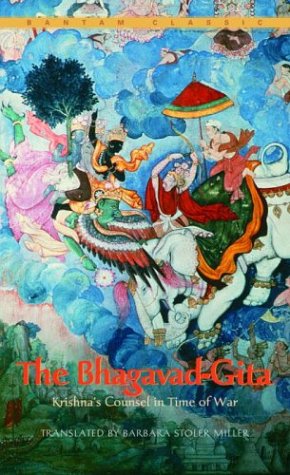
Dilemmas of a 'Global' Core: Reading the Bhagavad-Gita with First-Year Students (part 3 of 3)

By Nathan Rein


This leads me back to the “dilemma” in my title. To reiterate: when we ask our students to grapple with difficult texts like the Gita, particularly (though not exclusively) when we associate them with non-Western origins, should we foreground their strangeness, or do we build familiarity? In the little story I’ve told here, the Miller translation leans toward familiarity, and the Patton translation toward strangeness. Each has its obvious advantages and disadvantages. The Miller translation is resonant, sonorous, relatively easy to grasp, and intuitively appealing – but, by all accounts, it’s less faithful to the original. The Patton translation is conceptually precise and carefully documented, but it’s also hard to read. It contains many more proper names and untranslated Sanskrit terms, and it often avoids recognizably “spiritual” language. It’s not difficult to recognize in Miller a loosely Protestantized version of Upanishadic mysticism, an emphasis on transcending externals and overcoming temptations for the sake of attaining inner peace – the development of a sort of universal gnosis – and a corresponding deemphasizing of the particularly Indian elements of the text. Patton eschews these tendencies, but at the cost of accessibility and aesthetic power.

Here I'll offer one further illustration of this difference. In a conceptually difficult passage, Miller’s language – though far from simple – sticks close to literary English convention:

 A. Eternal and supreme is the infinite spirit; its inner self is called inherent being; its creative force, known as action, is the source of creatures’ existence. (p. 79, 8.3)

Patton, by comparison, is dense and technical. Even the syntax seems contorted.

 B. Brahman is the highest imperishable; the highest self is said to be one’s own nature, giving rise to all states of being; action is understood as “sending forth.” (p. 94, 8.3)

Here, again, there is a recognizably “spiritual” quality to Miller’s diction, which I can’t help but think Patton is self-consciously avoiding. “Eternal and supreme” is a recognizably theological way to describe a god; “the highest imperishable” sounds like something you might find among the canned goods in your grandparents’ fallout shelter. The phrase “action is understood as ‘sending forth’,” again, verges on incomprehensibility, whereas “the source of creatures’ existence” is relatively straightforward.

The examples could be multiplied. Miller offers us something that we can grasp with relative ease, something that fits with our own preexisting notions of what a religion – and specifically an Eastern, highly “spiritual” religion – should look like, where Patton challenges us with diction and syntax that make clear the extent of the problem, reminding us of how little we really know about the Gita’s intellectual world.

So what do we make of this? Pedagogically, the obvious “right” choice here is to foreground neither strangeness nor familiarity but rather to create an environment where a dialogic interplay of strangeness and familiarity can form the ground of learning and genuine engagement. On the other hand, though, we had to pick one of these two translations to use. I have to confess that I don’t have a resolution to offer here. It is my hope, at least, that a clearer awareness of these inescapable choices can help inform my own teaching as I return to the Gita in the fall of 2016.

Citations:

Miller, Barbara Stoler, tr. and ed. The Bhagavad-Gita: Krishna’s Counsel in Time of War. New York: Bantam Books, 2004.


Patton, Laurie L., tr. and ed. The Bhagavad Gita. London; New York: Penguin, 2008.

Tuesday, October 20, 2015

Dilemmas of a 'Global' Core: Reading the Bhagavad-Gita with First-Year Students (part 2 of 3)

By Nathan Rein


The two quotations I began with, as I noted, are drawn from two different translations of the Gita. Which one is better for freshmen? I think it depends on whether you want to emphasize strangeness or build familiarity, and for the remaining time I want to illustrate this tension a bit more concretely. Recently, I was involved in a small, but significant controversy on our campus, which I think exemplifies this dilemma of choosing between comfort and discomfort in our approach to these challenging texts. Here, in very condensed form, is the story. My institution's core course, the “Common Intellectual Experience” or CIE, begins with a Great Books-style sequence in the fall semester. As I’ve noted, most of the texts we read in the fall are drawn from the Western canon, but we devote three weeks to the Bhagavad-Gita and Mencius. From the time of the incorporation of the Bhagavad-Gita into the CIE syllabus up until two years ago, we have always used the Miller translation, which is the first of the two I quoted from initially. Since 2012, though, we’ve been using the newer, more scholarly, and slightly more expensive Patton translation, which was the source of that second quotation. I serve on the committee of four that administers the CIE, and part of the job that I’m responsible for is running the process by which the syllabus and reading list are updated from one year to the next. We follow a formal procedure, including a proposal followed by a faculty vote, for cutting texts, introducing new texts, or changing other fundamental features of the course, such as the writing requirements. On the other hand, the CIE committee typically institutes more minor changes, such as switching out one edition of a text for another, or making minor shifts in timing, without this voting process.

This raises an interesting question: in such a setting, is a move from one translation to another a major change that requires a vote, or a minor change? We initially chose to treat the change as minor. We moved to the Patton translation on the urging of a single faculty member, one of two on our staff who teach Asian studies, without a proposal or a vote.

But this choice proved problematic. Our CIE instructors come from all across the campus, including the natural sciences, and for many of them, leading discussions on Plato or the Bhagavad-Gita is a daunting prospect. After two years with Patton, many were fed up; they wanted to go back to the Miller translation, which was familiar and easier to work with. As a sort of procedural compromise, I didn’t require anyone to make a formal proposal for the translation change, but I did include a question about the translations on our annual syllabus vote. The overwhelming majority of faculty preferred to go back to Miller, and so it was decided.

It will probably not surprise you to hear that my colleague, the one who had originally pushed for using the newer, more scholarly translation, was not pleased with this outcome. He was scathingly critical of the Miller translation, to the point of suggesting that it was irresponsible to expose our students to it. On his view, omitting the Gita from the syllabus would be preferable to using this translation. Besides being inaccurate in many particulars, he said, Miller was also deeply Orientalist in character. Her translation choices supported a range of outmoded stereotypes about the supposedly mysterious, ascetic, spiritual bent of so-called Eastern cultures. Miller’s version, he argued, effectively lessened our students’ engagement in the thought of the Gita by conforming so neatly to common preconceptions.

(Part three available here.)

Friday, October 16, 2015

Interview with the Author: American Possessions, by Sean McCloud


Sean McCloud is the author of American Possessions: Fighting Demons in Contemporary United States

What is the main argument in this book?

First, thank you for inviting me to speak with you, I really appreciate it. The focus of American Possessions is Third Wave Evangelicalism, a movement focused on fighting the demons that practitioners see pestering and inhabiting human bodies, material objects, places, and regions of cities and countries.  In brief, I argue that this movement and its practice of spiritual warfare exhibits several prominent themes that characterize contemporary U.S. cultures. Specifically, consumerist, haunted, and therapeutic discourses saturate contemporary American religions and converge in Third Wave Evangelicalism. In addition, I examine how the movement’s theologies and practices reflect and contest contemporary neoliberal discourses concerning agency, social structure, history, and conceptions of individuals. In other words, I think that an examination of Third Wave spiritual warfare reveals a lot about American religions and cultures in the twenty-first century.

What motivated your work?

I was originally working on another book project when I kept having happenstance encounters with people whose ideas and practices tapped into Third Wave spiritual warfare. I found the subject fascinating, but even more I found that it seemed to touch in many ways on a number of issues prescient to the study of contemporary American religions. I ended up dropping the other book project into a file and focusing on the research and writing that became American Possessions.

What theory or theorists inform your methodology?

I found a number of writers good to think with. These include Eva Illouz on therapeutic language; Jean Comaroff, Birgit Meyer, and Matthew Wood on neoliberal consumer capitalism and religion; and Avery Gordon on haunting. And--even though he is cited just once in the book--the work of Pierre Bourdieu haunts nearly every page.  At base, the approach I take in this and all of my work is what might be considered materialist social theory. By this I mean that I am interested in how social structures, histories, and material conditions shape our consciousnesses, bodies, and practices by fomenting comfort/discomfort and making certain ideas and actions appear more natural and commonsense than others.

How might the book be used or how has it been used in a classroom?

Several people told me that they have already used the book in a class since it came out in May, but I am not sure how they used it. I could imagine it being assigned in courses on contemporary American religions, the supernatural in American culture, religion and capitalism, and theories and methods courses.

How do you think students would most benefit from your book?

This is a tough question because I am not a fan of self-promotion and these sorts of queries can lead to that, infused as they often can be with passively phrased boasting about the usefulness, importance, and lasting significance of one’s work. Don’t get me wrong—I think I’ve written a pretty good book. But I am growing weary of academics promoting themselves and their scholarship in ways that seem propelled by the very neoliberal consumer capitalist discourses that this book discusses. I guess I will leave it by saying that I hope the work conjures up some of the ways that those things we call religion, popular culture, and economy are historically and materially intertwined. And, perhaps even more, I hope it reveals how practices, ideas, and conceptions of self are not separate from, but rather dependent upon, the social structures within which they reside.

Tuesday, October 13, 2015

Dilemmas of a 'Global' Core: Reading the Bhagavad-Gita with First-Year Students (part 1 of 3)

by Nathan Rein


Most of us in Religious Studies are accustomed to teaching with texts in translation. And most of us, accordingly, know that translations -- especially translations of major primary texts -- can differ from one another in significant ways. Even so, I sometimes find myself surprised at just how significant those differences can be. Recently, discussions at my institution over the use of the Bhagavad-Gita in our required first-year seminar provided a glimpse of both the pedagogical implications and the ideological dimensions of choosing a translation for a course.
Compare the following two translations of teaching VII, verse 25 of the Bhagavad-Gita:
 A. Veiled in the magic of my discipline, I elude most men; this deluded world is not aware that I am unborn and immutable. (tr. Barbara Stoler Miller, p. 76)
B. But I do not shine for all, wrapped as I am in the creative power of yoga. The confused world does not perceive me, as I am – unborn, and imperishable (tr. Laurie Patton, pp. 90f.)
In this line, the speaker -- Krishna -- is providing his disciple with an explanation for the fact that most people fail to comprehend Krishna’s own true, divine nature. The explanation is that Krishna continually projects an illusory, phenomenal, ever-changing procession of images (maya) into the world, which most mistake for reality. Only a devotee can receive and recognize, in his or her own consciousness, the real manifestation of Krishna as unchanging and undying. The first quotation, from Miller, has a poetic resonance marked by the echoing words “elude” and “delude.” With the terms “magic” and “discipline” it evokes an atmosphere of mystery and esotericism.  The second, from Patton, coalesces around the words “shine,” “wrap,” and “yoga,” yielding a more convoluted, conceptually and metaphorically difficult structure.
I begin with these two quotations because I think their differences exemplify a dilemma we face when teaching core texts, namely, the choice between making the strange familiar (version A, by Miller) and, with apologies for butchering T.S. Eliot, making the strange even stranger (Patton's version B). While we face this dilemma with many, or even all, of the texts we teach, it is intensified in the context of what I’m calling a “global” core. Those scare quotes are intentional, since the jury is still out on whether spending three weeks in a semester reading ancient Indian and Chinese texts in translation really does much to heighten our students’ awareness of the wider, non-Western world.
At my institution, all students spend their first semester taking a liberal studies seminar that examines twelve texts over fourteen weeks. Three of those weeks are devoted to the Bhagavad-Gita and to selections from Mencius (one and a half weeks each); the rest, to a greater or lesser degree, are recognizably Western, going from Plato all the way to Descartes. I say the the dilemma is heightened in the case of “global” texts because I think instructors inevitably find themselves, intentionally or not, presenting these texts to students – and students end up absorbing them – as if they represented the “non-Western world” in some broad, totalizing sense. Thus the Gita, the text I’m interested in here, is pressed into double duty: on the one hand, as a self-contained text and in its own right, it offers students a complex narrative full of challenging philosophical and religious claims, while on the other, it is supposed to provide a salutary and enlightening excursion into the bewildering but rewarding landscape of global, i.e. non-Western, cultures. In our classrooms, we end up repeatedly choosing between trying to ease our students into some, perhaps minimal, level of comprehension of the Gita, on the one hand, and making them sit with and confront their incomprehension and bewilderment on the other. By extension, the same could be said about other texts that serve (however unjustifiably) as proxies for foreign or exotic cultures, and indeed, about any text at all that speaks to us across a great historical or cultural distance. (As an aside, I want to underscore that I’m not arguing that the Gita, by virtue of being from India, is in and of itself necessarily more challenging, or more “different,” or more exotic and strange than, say, Aeschylus or St. Augustine; I think, however, that we – our students and ourselves – often burden these texts with associations of foreignness and strangeness as a result of their place in the curriculum.) This is, to an extent, a pedagogical choice between comfort and discomfort, and it is one that we make in our classrooms daily. Perfectly skilled teachers, I imagine – if they exist – can maintain a level of student comfort that lets them feel safe enough to engage, explore, and take intellectual risks, while administering just enough shock and discomfort to stave off complacency and stasis.

(Part two available here.)

Monday, September 28, 2015

Religion as Film: Constructing a Course as a Critique of a Dominant Paradigm

By Tenzan Eaghll

This summer I taught a class on Religion and Film, and I feel as though I had to reinvent the wheel. This was my first time teaching Religion and Film and I was shocked by the state of scholarship on the topic when I began constructing my syllabus. From the perspective of ideological critique, the area of study is rife with essentialism and is about twenty years behind current trends in continental theory. There are a few great books in print, such as Michael Ryan and Douglas Kellner's Camera Politica: The Politics and Ideology of Contemporary Hollywood Film, M. Gail Hamner's Imaging Religion in Film: The Politics of Nostalgia, and Gregory J. Watkins, Teaching Religion and Film, but many of the books on the subject imagine religion in essentialist terms.

The dominant paradigm used in the field is to treat "Film as Religion," which boils down to a mythological analysis of film. According to this perspective, film functions like a religion because it is a cultural projection of the deepest human values and beliefs onto the silver screen. Film is portrayed as a social glue that constructs symbolic universes of meaning. In his popular book on the subject, Film as Religion: Myths, Ritual, and Rituals, John C. Lyden uses this paradigm to develop "a method for understanding film as performing a religious function" (3). Building upon the work of Clifford Geertz, Lyden defines religion as "a "myth" or story that conveys a worldview," and suggests that films express these myths by using all the tricks of cinematography (4). Lyden uses this definition to explore how the artificial nature of filmic reality has the power to affect us religiously in the modern world.  

Another popular book on the subject, which is used as a textbook in many courses, is Joel Martin's and Conrad E. Ostwalt's, Screening the Sacred: Religion, Myth, And Ideology In Popular American Film. Like Lyden, the editors of this book also privilege mythological readings of film and devalue ideological analysis. The text is superior to the former book because it offers examples of theological, mythological, and ideological film criticism, but the editors repeatedly suggest that ideological criticism lacks the depth of theological and mythological perspectives. Moreover, the editors openly state their desire to study religion in film in order to uncover its essential qualities. As they write, the aim of the study is "to take the things of the spirit spiritually" (12).  The editors make the apt point that religion can't just be rejected as the "opiate of the people, a mystifying set of symbols and ideas," yet their correction to this error is to essentialize religion as an autonomous domain of culture (11).

Given the state of scholarship on the topic I decided to construct my Religion and Film course as a critique of the "Film as Religion" paradigm. Instead of privileging theological and mythological criticism, or simply inverting this model and privileging ideological criticism over the former two, I treat "Religion as Film," and interrogate how films present religion on a symbolic and technical level. This means that rather than looking for the "religious power" in film as Lyden, or taking the things of the "spirit spiritually," as Martin and Ostwalt, I present religion as a modern cinematic creation without essence or origin. The fundamental thesis of my course is that religion is not a thing with definite qualities but a symbolic and technical production of popular culture. Religions are often portrayed as static and insular traditions that stand in opposition to (or in conflict with) popular culture, but my course explores how films challenge this perception by creating, mimicking, and influencing our understanding of religion.  Following the lead of Gail M. Hamner in her syllabus on the topic, I treat religion as an "occasion for analysis," not an "object of analysis." The films I screen in class and the readings I give students do refer to  Christianity, Buddhism, Islam, indigenous traditions, and new religious movements, but I do not use any as authoritative presentations of religion. Rather, I present the films and the readings as attempts to frame the relationship between reality, symbols, and society.

Since there are no textbooks that expose "Religion as Film," I have used  Martin's and Ostwalt's Screening the Sacred, but juxtaposed this text to alternate forms of criticism and analysis from film studies. First, rather than simply screen the films and readings from Screening the Sacred in a chronological order, I have mixed things up by showing how the types of criticism the editors select in this volume are not mutually exclusive. Whereas Screening the Sacred is divided into three neat sections, each of which provide a different type of criticism - theological, mythological, and ideological - I blur the distinction between these forms of analysis by providing students with competing theoretical articles, and inviting them to make up their own minds about what type of criticism is most dominant.  Second, each week I also supply students with readings from Timothy Corrigan's, The Film Experience and Louis Giannetti's, Understanding Movies. These readings provide the technical terms from film studies that are necessary to understand how film images are created by directors, cinematographers, writers, actors, cameras, lighting, make-up, costume, etc.

For instance, on week two we watched Oliver Stone's first Vietnam War flick Platoon (1986), and read a wonderful essay from Screening the Sacred on how the entire film functions as a New Testament allegory. According to a theological reading, Platoon offers a  critique of the American war effort by making stark claims about absolute good and evil, and providing a narrative of redemption in Christological form. However, in addition to this theological reading, the students also read an essay that offers an ideological critique of the film. According to this second reading, Platoon reinforces the American War effort by obscuring deeper political considerations and sustaining various myths associated with American nationalism. Of course, the point of this juxtaposition of critical readings is not simply to show how multiple interpretations are possible - a point most undergrads already accept - but to get the students to notice what technical aspects of the films these differing arguments rely upon. It is obvious that a film such as Platoon can lend itself to multiple readings, but what are the cinematic elements that support these various perspectives? What sort of cinematic style does the director use to get his point across; realism, formalism, or classicism? How does the plot and character development use religious ideas to facilitate this cinematic style? How about Symbolism and imagery, is it used to endorse or critique religion? Moreover, what about the use of dialogue and monologue, who is telling this story? Is there an omniscient narrator, narrative, or theme, or are all the characters subject to the whim of chance? What is the tone of the film and how do all the special affects support this tone? And, perhaps most importantly, what about music, lighting, makeup, costume design, etc.? How do all these technical factors combine in the mis en scene of each camera shot? How does each image frame religion as something to be observed, felt, or critiqued? Hence, I use the types of criticism in Screening the Sacred in conjunction with critical analysis from film studies to expose how religion is presented through film, not as a guide for uncovering the religious essence in film.

Fundamentally, what interests me is what films do with ideas and images, not defining religion in any particular way. At no point in the class do I provide a strict definition of religion. Rather, I invite students to examine how the films and the readings tell us to think, feel, and imagine religious content. What I continually ask everyone to consider is how religion is talked about in film, and to explore all the intellectual assumptions and technical aspects that go into the creation of images and effects on the silver screen. In a sense, what I ask them to consider is how everything we think we know about religion is created by filmic reality. By reversing the paradigm of "Film as Religion" with that of "Religion as Film," I invite students to consider how cinematic production creates the very content of religion in popular culture.

Tuesday, May 12, 2015

Multiple Choices

By Russell McCutcheon


I went up to Chicago about a month ago to give a talk on teaching the introductory course and in the midst of all the critical thinking talk there was a question that cut to the heart of the theme of my talk (on the tough choices we likely need to make when teaching such courses); it concerned the fact that I use multiple choice tests.
The course I have in mind, and for which I’d shared my syllabus, is one of our main 100-level undergrad classes, and it enrolls between 100 and 150 students per section, with a couple different sections (i.e., different profs teaching their own version of it) per semester. When I teach it (which is at least once a year) I use my own book and I also use multiple choices tests that focus both on lectures as well as content in the book. By the way, the book contains bolded technical terms (i.e., the first time a term that’s defined in the glossary is used in each chapter it is bolded) and also bolded scholars names (they too are discussed in greater detail in the back of the book, with a few quotes that illustrate their approach to defining and studying religion); one of the reasons why the chapters are all so short is because each chapter, somewhat like clicking links on the web, opens onto both a variety of interconnected paragraph-length discussions of terminology later in the book as well as several two to three page discussions of the scholars that are mentioned. This format then paves the way for the tests which, in part, emphasis the terminology as well as the scholars. So I ask the students to learn at least four or five things about every new term we discuss and also to be able to talk about each scholar mentioned in at least three ways: roughly when did they live (don’t memorize birth and death dates but know if they’re a late 19th century writer or a contemporary one); what part (aka academic discipline or department) of the university they worked in; and why they were relevant for us in our course.
But back to that question: why the multiple choice tests? Don’t they cut against some of the things that I’m trying to accomplish in such a course? After all…, multiple choice tests are…, are…, well, let’s just be honest: they’re multiple choice tests.
When I was a teaching assistant during my own Ph.D. at the University of Toronto, I TA’ed for a couple years for the late Will Oxtoby and the late Joe O’Connell’s world religions survey course. (You likely know the two volume textbook that, to a large extent, resulted from that class.) There was a whole team of us (5 or 6?) for a class that likely wasn’t larger than 200 students, and, as I recall, we all ran a couple tutorials (aka discussion or recitation sections), one before and one after the main lecture, so that students had the opportunity to participant in a small (20 students or so?) discussion, thereby not getting entirely lost in the large lecture. Bill Arnal and I did the same for Michel Desjardin’s night course intro to the New Testament one year as well—leading small discussion sections before and after the large, main lecture. The first large lecture class I taught on my own was when I first started working fulltime, back in Tennessee in 1993, and I’ve been doing them ever since, but, unlike those classes I worked for in Toronto, I’ve never had the luxury of a team of TAs able to staff multiple discussion sections; instead, like most people around the country, I’ve mostly done it on my own but, if we’re lucky (as in the last few years here at Alabama), we have one TA, assigned to the course for about 10 hours per week (what we’d call a half TA assignment), but that’s hardly enough personnel to offer smaller discussion sections of 100 or 150 students. That means that our TAs help with grading, keep the grade book, offer office hours, etc.—for just attending the class exhausts three of those 10 weekly hours, leaving not a lot of time to run multiple discussion sections.
So, given this practical setting, writing assignments are likely not a possibility in this course—I’m a Department chair and, besides a 100-level intro course, there’s lots of other things competing for my attention each day and I can only imagine what life would be like if, like earlier in my career, this were one of several classes I was teaching each Fall or Spring—whether different preps or not, all that grading adds up, especially when you’re also trying to do research and write. Which brings me back to those tough choices I mentioned: in those early days of my career, when I was finishing my dissertation and involved in a variety of other projects, I developed some group assignments and a style of multiple choice tests that I was willing to live with in this intro course—it was hardly ideal, given my own pedagogical hopes and dreams, but, given the practical circumstances of my labor, it seemed to be a compromise I could live with. And I’ve happily lived with it since then.
After all, I couldn’t help 150 students develop and write original research papers, much less read rough drafts, comment on them, and then grade them all. So the question became what could I do and what ends that I valued could these assignments help me to achieve.
And that’s how I settled on some small group work to start the class—on the most rudimentary level it’s a good way for students in a large class to meet someone, to learn where the library is, to have a taste, at the 100-level, of a required format for citing a source, and also a great way to discuss what it means to quote a source properly and what counts as plagiarism. So, for the second class of the semester, I send them all to the library, with a partner and with instructions to find 5 or so different definitions of religion, each from a different source (nothing from the web is allowed). They have to hunt and peck and flip through the table of contents and index of a bunch of books—which is a pretty good emulation of what it often means to do research, by the way; for we usually don’t know what we’re looking for when we start looking. Once they turn it in I keep ahold of that assignment and give it back to them at the end of the semester, when they now have to make data of those five definitions for their second group assignment. (Which definition is functionalist? Which might a scholar in a public university opt for—and why?)
It’s an assignment that allows us to apply things from the class, yes, but it also accomplishes so much more that, more than likely, the students don’t even realize.
But what about the multiple choice tests? Well, like that definition assignment, its more about form than it is about content—sure, you’ve got to know something about Freud and something about the notion of etic, but it’s more about how they study for it and how they come to learn, over the course of the semester, that the key is building relationship between the terms, about being able to link one seemingly discrete piece of information to another and then to another, and maybe another as well, making semantic webs, if you will, so that when I come along and throw a little curve at them by introducing a new ball into what they’re already juggling they’ll be able to accommodate the new information and link it to something they already know, which in turn they’ll link to yet something else and, like solving for X in a quadratic equation, they’ll then look among the various choices I’ve offered for the correct answer. For, come to think about it, that’s what the course is all about: studying how we create knowledge, make spaces sensible and habitable, by establishing and then managing a host of relationships of similarity and difference—our field’s been known as Comparative Religion, after all, no? So the multiple test exemplifies the method at the heart of our discipline: comparison.
But it doesn’t just test this, for I tend to write rather long questions, making it a test of reading comprehension as well. (Who among them will write the GRE or the LSAT someday…?) Often, students perform unsatisfactorily though they say that they know the information—their difficulty is linked to reading, to being able to simplify the sentence, to find what it is actually asking, in distinction from the background info it’s also giving them. Did they see the word “not” in the question, to then realize that I was asking the exact opposite of what they at first thought? So, instead of asking how Karl Marx defined religion I’ll instead start off the question by writing two or three lines, beginning with something like: “A 19th century political economist whose functionalist definition was concerned with distinguishing…”; it’s a confusing approach for some students, for they get lost in the verbiage, but, for others, they see that I’ve just given them all sorts of hints and prompts, inviting them to make certain sorts of connections—especially helpful if he’s the only political economist, let alone from the 19th century, whom we’ve studied. But the goal—which I let students in on should they take the trouble to make an appointment to talk over the problems they seem to be having in the course—is, again, to exemplify how knowledge itself works: by making links and moderating that series of like/unlike relationships. And those who come to office hours start to “get” this and, as you’d hope, they tend to stick around a little longer during the tests (why do they all race through them?) and their grades inevitably improve. And since it strikes me that the course—by the way, like a lot of 100-level classes, it counts for what we call a Core Humanities credit, as part of our General Education curriculum—is actually about learning how to learn, late in the semester I often offer all the students a chance to reweight their tests, to minimize on poor early performances by maximizing on their newfound skills.
And for many it pays off. Sometimes dramatically.
It’s not ideal, of course—who wouldn’t rather be teaching 10 students in a small seminar room à la Dead Poets Society, where you can look each student in the eye to figure out whether they understand the material or not, having them each do weekly writing assignments on which you can comment at length, to see them incorporate your feedback and continually improve across the semester. But that’s not where many of us work—and, in the modern university, those conditions are getting further and further away from many of us. So it seems to me that one is challenged to figure out what’s important to you, as an instructor, and to devise assignments that take your time commitments into account but which also strategically address those pedagogical values and goals you have and on which you’re not willing to compromise. And being placed into a setting such as that, where the teaching situation might be far from ideal, is what I think makes good teachers for it prompts us to be deliberate and mindful about what we’re doing and how we’re going doing it.
So yes, I use multiple choice tests in my 100-level intro course, but because of some of the choices I’ve made, I think they’re doing a lot more than meets the eye.